
What is a rotator cuff tear?
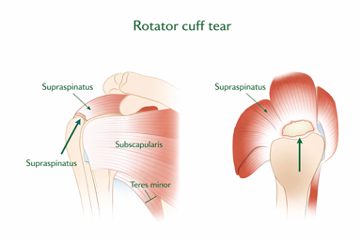
The rotator cuff is a group of four muscles that come together as tendons to form a "cuff," or cover, over the head of the humerus (upper arm bone). The four muscles — supraspinatus, infraspinatus, subscapularis and teres minor — originate from the scapula (shoulder blade). The rotator cuff tendons then cover the head of the humerus in specific areas of the bone referred to as the greater and lesser tuberosities. These tendons are important in helping you lift and rotate the arm, while stabilising the head of the humerus within the shoulder joint.
A rotator cuff tear may result from an acute injury, such as a fall, or may be caused by normal aging-related wear and tear with degeneration of the tendon. Typically, you will feel pain in the front or side of your shoulder that radiates (travels) down the side of your arm. It may be present with overhead activities such as lifting or reaching. You may feel pain when you try to sleep on the affected side, and note weakness when performing routine activities such as combing hair or dressing. If the tear occurs with injury, you may experience acute pain, feel or hear a pop, and notice immediate weakness of the arm.
A rotator cuff tear can extend or get larger over time. This can occur normally over time, or with repetitive use or a re-injury. It is common for patients who have been diagnosed with a rotator cuff tear to experience acute pain and weakness following a minor shoulder injury. When this happens, it may mean further tearing of the existing tear, and is referred to as an acute or chronic tear.
The majority of rotator cuff tears can be treated nonsurgically using a combination of physiotherapy, anti-inflammatory medications and cortisone injections, with the goal to restore strength to the affected shoulder. Even though most tears cannot heal on their own, you can often achieve good function without surgery. This is because there are many other muscles and tendons that help move the arm and can compensate.
Surgery may be recommended:
• If you have persistent (ongoing) pain or weakness in your shoulder that does not improve with nonsurgical treatment, including a dedicated course of physical therapy
• In active individuals who use the arm for overhead work or sports, such as throwers (e.g., baseball pitchers), swimmers, tennis and volleyball players, construction workers, painters, and electricians
• Sometimes, for complete tears that are acute (i.e., due to a specific traumatic event)
The type of repair performed is based on the findings at surgery.
• A partial tear may require only a trimming or smoothing procedure called a debridement.
• A full-thickness tear, which usually means the tendon is torn from its attachment point on the humerus (the most common injury), is repaired (stitched) directly to the bone. This can be performed arthroscopically or open, or a combination of both.
Rehabilitation plays a critical role in both the nonsurgical and surgical treatment of a rotator cuff tear. When a tear occurs, there is frequently atrophy (wasting or weakening) of the muscles around the arm and loss of motion of the shoulder. An exercise or physical therapy program is necessary to regain strength and improve function in the shoulder.After surgery, the repair must be protected from certain activities that may put healing at risk. As such, a physical therapist can provide a safe and progressive therapy program. Even though surgery repairs the defect in the tendon, the muscles around the arm remain weak, and a strong effort at rehabilitation is necessary for a successful outcome. Complete rehabilitation after surgery may take several months or even up to a year.