
When do I need to get my distal radius fracture fixed?
A broken wrist often raises a lot of worries; people wonder if it will mean months in plaster, a bent wrist that never looks right, or never getting full movement back.
In some cases, if the break is simple and the bone is still in place (an ‘undisplaced’ fracture), it can heal well in a plaster cast or splint. These injuries do need regular X-rays to make sure the bone doesn’t shift while it heals.
Other fractures are more complex and often need surgery. This includes breaks that extend into the joint (‘intra-articular’), those with several pieces of bone (‘comminuted’), or where the bone has slipped out of position (‘displaced’). If these aren’t treated properly, the bone can heal in the wrong place, leading to pain, loss of movement, or problems with rotation and grip.
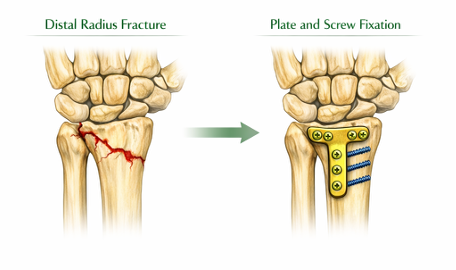
The complexity and severity of the fracture will determine the type of procedure offered. For many distal radius fractures, the bones can be repositioned and fixed with plate and screws to restore a stable platform for the wrist and allow early movement. If the fracture involves the joint then arthroscopy (key hole surgery) is used to assist the reduction of the bones. This allows restoration of the joint surface under direct vision during the placement of plates and screws, with the aim of reducing the risk of long term arthritis. Very occasionally the fracture is too complex to be fixed successfully with the standard plate and screws, and additional plates or bridging of the radius to the bones of the hand may be required.
Typically distal radius fracture take 6-8 weeks to heal. Splint support and gentle range of motion commences early, and is supported by hand therapists who will guide recovery, strengthening and movement.